

How Much of Your Work is an Epicycle?
Some of the hardest work you do exists only to protect a belief that stopped being true.

Does something that you’re working on or living through feel off and you can’t quite pinpoint what’s going on? Like you’re doing a bunch of performative makework or merely putting your time in somewhere in your personal life?
It might be that you don’t understand aspects of what’s going on at work or you’re misaligned somewhere. But there’s a good chance that you intuitively know that there’s some paradigm you’re working from that’s not tracking reality.
When some part of you knows something is wrong, the story about the work saps more energy than the work itself. Your tension may not be about you, but instead the fact that you’re dealing with an epicycle.
I’m lifting the word “epicycle” from astronomy and the philosophy of science. It comes from a centuries-long stretch where brilliant people collectively built an enormous amount of work to avoid changing one wrong idea.
The History of Epicycles
Before astronomers realized during the Scientific Revolution that the Earth orbits the sun, they operated under two assumptions from Ptolemaic and Platonic thinking: (1) the Earth was the universe’s center and (2) celestial bodies moved in perfect circular orbits.
The circle wasn’t a random geometric choice. It was a philosophical choice because heavenly objects were perfect and the circle was a perfect form. So it was axiomatic that we had circles moving in circles.
Celestial bodies moving in circular orbits at uniform (perfect) speed allowed us to mathematically predict their positions. The problem was that the planets didn’t show up where the math said that they should.
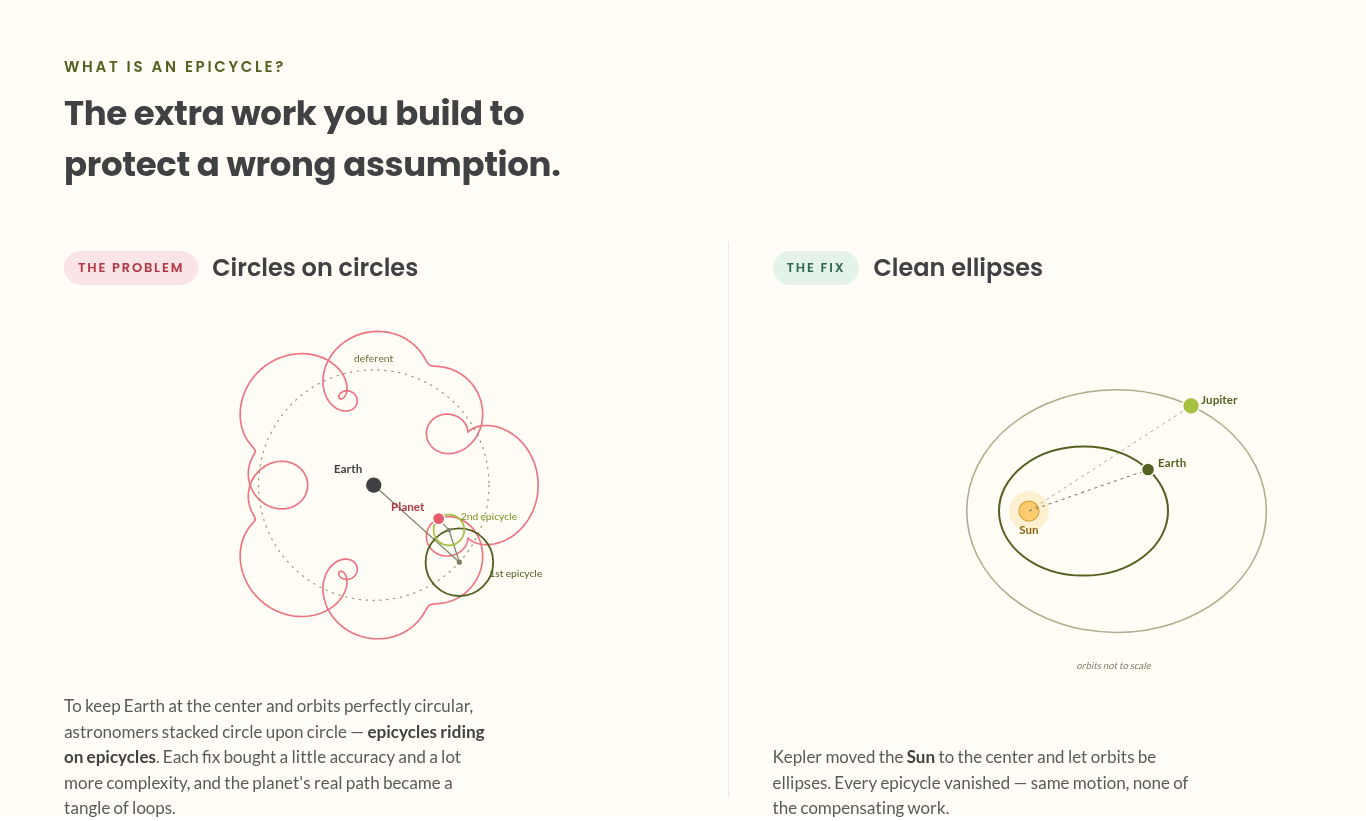
The astronomers didn’t change their models, though. They added complexity — small circular orbits on larger ones — called epicycles. Voila! Circular bodies still moved in circles, but they were circles on circles now.
One epicycle didn’t fix the problem, so they added more circles. The math got ever more complicated but still didn’t work.
Copernicus moved the Earth out of the center but kept the perfect circles, so his model still needed some epicycles. His move made the epicycle model more accurate, but it was Kepler’s move that removed the need for epicycles entirely.
An epicycle is what we build when reality contradicts our beliefs but we add work to maintain the beliefs rather than update them. Beliefs, models, and paradigms are often wrong and that’s fine.
The problem is the effort needed to maintain a belief. That’s where the exhaustion and suffering come from.
Why We Keep Building Epicycles
All beliefs and scientific models are provisional. The history of human knowledge is largely a history of good-enough models being replaced by better ones. The scientists and thinkers who built the good-enough models weren’t fools — they worked with what they had. Holding your models lightly and staying open to revision is generally good intellectual hygiene.
One of my favorite quotes attributed1 to Bertrand Russell points at this:
The whole problem with the world is that fools and fanatics are always so certain of themselves, and wiser people so full of doubts.
At some point, we stop being open to revision. It’s not just that we can’t see the beliefs we’re holding tightly to; we become hostile to questioning them.
When something isn’t working, we can either update the model or add an epicycle. Most of the time, we add the epicycle.
We do this because models aren’t just ideas. They’re tied to identity, authority, culture, and comfort. Changing a model means admitting that something you’ve organized your life, work, or organization around isn’t true. So instead of doing that, we add another layer of effort to make the evidence fit what we believe.
It’s not just that something isn’t true, but how much of your life and resources you’ve invested in upholding the model. This tension rides along the same neural grooves as the sunk cost fallacy.
So we keep operating as if the belief is true. The work accumulates. And somewhere in the background, the exasperation keeps building because part of us already knows something is off.
Alas, we so quickly assume that we’re what’s wrong, broken, or uniquely defective. Because many of us don’t socialize our cognitive dissonances, we don’t know that others struggle with the same dissonance.
You might recognize this pattern from a different angle. In Team Habits, I wrote about broken printers — small, fixable dysfunctions that teams learn to work around instead of addressing. The printer stays broken not because it couldn’t be fixed, but because fixing it would require admitting that working around it has become the norm.
Broken printers are often epicycles in disguise. The workaround persists because somewhere underneath it is a belief that makes addressing the root cause feel unnecessary or not worth the disruption. The epicycle turns a fixable problem into a permanent feature of how the team works.
The Personal Epicycle: When Easy Feels Like Cheating
I have a client whose work, at its best, is effortless. The ideas flow, the execution feels natural, and when she’s in it, she doesn’t have to force anything.
Sounds great, right?
Wrong.
To her, the effortlessness doesn’t feel like mastery. It feels like evidence she’s not earning it. So she builds difficulty back in. Not because it helps — it doesn’t — but because it makes the work feel legitimate.
Underneath all of it is a belief she never named out loud before we started working together: if it’s easy for me, I must be doing something wrong.
Easy feels like cheating. She’s not a cheater, so she makes the work harder.
A major part of our work together has been rebuilding her business and life to remove the unnecessary shoulds and difficulty.
Initially, she got it and agreed. For a while, she’d find flow, ease, joy, and momentum in her work.
But then she’d start thrashing.
She’d feel the urge to buy a course on a topic she’s already excellent at. She’d resist the warm-ups that get her into her best work. She’d find ways to make the work harder and more structured to feel real.
All those behaviors were epicycles riding on the belief she had to work to change.
She’s doing much better now. Instead of buying courses, she travels to meet colleagues or just to enjoy herself. The warm-ups are still a work in progress.
Maybe you don’t buy courses you don’t need. But maybe you over-prepare for conversations you could have off the cuff. Maybe you run your best ideas through three more rounds of revision after they’re already done. Maybe you’ve built an elaborate process around work that you could do in half the time and you’d feel vaguely guilty if you did.
There’s a good chance you have a version of this belief. Don’t believe me? Pick something you’re stuck on and ask what’s the simplest possible way you could move it forward. Notice if you reject the simple option.
The Organizational Epicycle: Return-to-Office
The belief behind most return-to-office mandates is simple: “If I can see you working, I know you’re working.” That’s the model industrial management was built on. Before the pandemic proved it, it was already wrong for a lot of knowledge work.
Instead of updating the belief, most organizations added epicycles: badge tracking systems, hybrid attendance policies, elaborate “culture” justifications, productivity theater, and an endless cycle of leadership debates about what the data really means.
Some organizations have real reasons for wanting people together. Great reasons for bringing people together are mentorship, onboarding, and collaboration that genuinely don’t happen remotely. But you can usually tell the difference between these legitimate cases and the epicycle cases.
The people inside that system aren’t just doing unnecessary work at work. They have to arrange their personal lives around the paradigm. They have to invest time, energy, attention, and money in commutes, childcare, schools, caretakers, therapists, recovery trips, and food to sit at a desk and put headphones on to talk to people somewhere else.
During the Team Habits tour, I said it many times: expect exasperation and rebellion when you make workers drive two hours a day for half their day to be on virtual calls and another third in digital comm tools like Slack and email. All because you believe that people are universally more productive in the office and that any hybrid work culture is inferior to a co-located culture.
In the teams I’ve advised, people are actually fine with commuting and traveling when it’s clear from the work itself that they need to be together. Extroverted teams or members needing to be somewhere other than home also choose to commute and be co-located.
A reductive analysis is that it’s the same amount of work whether people accept the co-located paradigm or not. However, this misses the extra cost of cognitive dissonance, an unspoken agreement to avoid the topic, and the whole-system fatigue that shows up at work and actually makes the organization less effective.
The Cultural Epicycle: Urgency as a Value
The omnipresence of smartphones and wearables has covertly made urgency a cultural value. If someone or something doesn’t receive a fast response, it’s deemed less important.
This one cuts across our personal lives and our work.
Some urgency is real and obvious. The stakes set the pace for an ER, firefighters and soldiers, a trading desk during a selloff, a newsroom on election night, or a startup with eight weeks of runway. The tell for real urgency is that it comes from outside: a customer with a reasonable need, a deadline with teeth, or an emergency whose consequences exist whether or not anyone’s paying attention.
Artificial urgency comes from inside. It’s generated to make ourselves or the work feel important or to keep slack out of the system.
In our personal lives, friends and family expect near-immediate responses to texts and emails. People expect quick engagement from their friends and family on their social media posts. We under-plan because we can always get information instantly, even if it means asking our partner what to add to the grocery list while we’re at the store.
I’ve lost would-be friends because I don’t operate on this urgency. My best friends understand that I may not respond to a non-urgent text or Marco Polo for days or a week. But they also know that when I’m with them, they get 100% of my attention because I’m not checking my phone or watch to see who else I need to be interacting with.
Many workplaces run on the belief that if something is important, it must be urgent. Instead of questioning this belief, they create urgency as a signal of importance. They create fire drills, last-minute pushes, and constant escalation that treats everything like a crisis.
The urgency is the validation. It’s how the system proves to itself that something matters. Once you see that, the fire drills start to look less like poor planning that occasionally demands heroics and more like a lever managers use to force focus and motivation — Dunkirk Spirit turned into a permanent operating mode instead of the rare event it’s supposed to be.
The cost isn’t just lost time. It’s the chronic low-grade stress of living in manufactured crisis that accumulates without a clear source because the source isn’t the work. It’s the epicycle the work is being run through.
This Isn’t Just You or Your Organization
Thomas Kuhn showed that even scientists, trained to follow evidence wherever it leads, rarely abandon a failing theory upon encountering contradicting data. They spend years explaining away anomalies, adding exceptions, and defending the model, waiting for someone else to blink first.
Those years of defending a failing model weren’t just intellectually wasteful. They were years of real people doing real work that didn’t need to exist.
If that’s how scientists behave, expect it to be more entrenched in our organizations and lives, where the stakes feel more personal and the social costs of changing the model are higher.
Donella Meadows described leverage points: places in a system where a small shift produces outsized change. Most interventions happen at the surface level, with new rules, processes, or structures. That’s exactly where epicycles live.
Meadows argued that the highest-leverage point is the paradigm itself. Change the underlying beliefs and everything built to compensate becomes unnecessary.
Spotting Your Own Epicycles
The most useful question for spotting epicycles is “What work only exists because we’re protecting an assumption?”
Look for an opaque malaise, flashpoints of exasperation, and dulled eyes. Look for people who have trained themselves not to see because seeing is more confusing and painful than being blind.
Look for meetings that exist because “that’s how we make decisions here.” Look for approval layers that don’t catch anything, reports no one reads, and processes that serve other processes that don’t seem to drive outcomes or align with how people want to be.
In every sector I’ve advised in and every context I’ve seen, people come alive when there’s a compelling problem or puzzle to solve and they feel like they can actually do so. When given the chance and resources to tackle a meaningful problem or puzzle, people do so.
When tasked with or living in what amounts to maintaining an epicycle they can’t change, people check out or do the minimum they have to. Seeing this as a character flaw when it’s a coping strategy incorrectly makes individuals the problem, when the model has been the problem all along.
Changing the Model … and Then Changing It Again
The breakthrough in astronomy didn’t come from better epicycles. Copernicus didn’t build a smarter version of the old model. He moved the center and that eliminated some epicycles.
But not all of them. There was still a second assumption hiding underneath the first.
It took Kepler replacing circles with ellipses to finally let the entire compensating structure go. Two wrong assumptions. Two paradigm shifts. Only then did the system simplify.
I think about that whenever someone says they’ve already tried to change things and it didn’t work. Usually, they did change something real but didn’t find the second assumption. Meaningful change in complex lives and organizations rarely happens in one move.
Most of us are carrying more work and suffering than necessary because we maintain unnecessary circles.
To close the loop I opened at the beginning, that weight you may be feeling is probably not about you. You’re feeling the weight of a belief or model that costs more to maintain than it’s worth.
Instead of adding yet another epicycle or making yourself blind again, the courageous choice is to update the belief or model so that it doesn’t need an epicycle. Especially when you’re the one holding onto the model and expecting others to do so, too.
His actual quote was “the fundamental cause of the trouble is that in the modern world the stupid are cocksure, while the intelligent are full of doubt.” In his time, it was assumed that the cocksure were fools and fanatics and intelligent people were wise(r). So much work in the humanities during the twentieth century invalidated these assumptions that were themselves epicycles.
This was very well-written, and much-needed. Thank you.