

Do You Have an Idea Garden?
It's not just about planting your ideas somewhere — these seeds need sun and water


Where do you plant your idea seeds? How do you give those idea seeds the love and attention they need to become your next great idea?
From my experience, most people have the hardest time at the incubation step in the creative process. We all have good ideas, but some of us don't do a good job of capturing those ideas and tending them until they're ready to come out. Hence the need for every one of us to have at least one idea garden.
An idea garden is simply a place to park your ideas. But it's not just about planting your ideas somewhere — these seeds need sun and water, as it were. Without getting the energy and attention they need, they'll become just more ideas that never see the light of day.
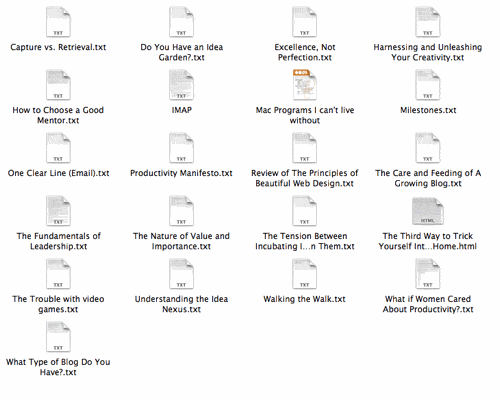
To make this concept more tangible, I'll use my blog idea garden as an example. In a folder on my server are a bunch of text files, each with a title that represents the idea or topic for the post. Here's what it looks like:
[2/2/23 Update: This post was written long before Notion, Obsidian, Drafts, and Ulysses existed. I currently keep my idea garden in Drafts and Ulysses, depending on how much I've tended them. Different tools, same principle.]
But it's more than that. Each file has a brief abstract of what I was thinking. For instance, here's the text from "The Tension Between Incubating Ideas and Dwelling Upon Them":
There's a very delicate balance between giving some time for incubating ideas and dwelling upon them for too long. If you try to push the idea out before it's ready, it lacks the richness of a well-formed idea. On the other hand, if you hold on it too long, it loses its power and can become forgotten. Learn how long to hold onto an idea before sharing it — because great ideas are a social product.
As you can see, I have enough information to write a blog post on that. But, more importantly, you can see how that post connects with the one you're currently reading: because I'd been thinking about that problem, I started thinking about a way to keep the ideas growing. This explains, to some extent, why many of my posts are so tightly linked to each other — the ideas don't come from a vacuum each morning. Rather, I tend the idea garden and nurture ideas, and most of the time, they link to other ideas.
Of course, this also explains why I have to be careful how much I write: the more I tend the idea garden, the more idea seeds I get. The more idea seeds I get, the more I feel the urge to write. The more I write, the more I tend the idea garden. It'd be a great process if blogging and writing were the only things I did.
Another reason I do it the way I do it is because it's relatively fiddle-proof. If I have an idea, I'll start a new text document, write the idea in the text window, and get back to whatever else I was doing. When I'm done with that, I'll come back to the seedling, name it, and save it in the garden.
If I see that it needs some more work or that it connects with another idea in the garden (or on the blog), I'll highlight that and then save it. Sometimes, if I have time, I'll go ahead and write out the post. The main point, though, is that the seedling is there. It's not lost somewhere in my head, and I'm not monkeying around with the app du jour to see how it works.
At least once a week, I'll go through the garden, open up every seedling, and see what needs to be tended. Usually, I'll have a good feeling about when I need to write a post based on how it relates to other ideas or how excited about or interested in the idea I am. After I write the post, I'll move that seedling to my "completed posts" folder.
A downside to doing it this way is that I sometimes get bottlenecked — I see that for presentation purposes and logical flow, I need to write about certain ideas before I write about others. There is a tendency to get stuck on the preceding ideas, but I've gotten better about disregarding that and writing, but not posting, later ideas just so I can see the best way to lead into them.
Enough about my process and metaphors. The reason this works is because the tending of the garden is both Preparation and Incubation. (Tweet this.) The actual technique may be idiosyncratic, but the principles of the technique can be applied to any creative pursuit.
A graphic designer may have a folder or notepad with half-drawn drafts that she reviews in the morning. A musician may have bits of a song that he plays while getting in the creative groove. An entrepreneur may just have a scrapbook of problems with potential solutions. A painter may display silhouettes of ideas on her canvasses in a separate place from her main work area.
It's hard for me to give specific advice here on how to set up your idea garden because it's really dependent on your workflow, processes, and creative pursuit. However, having an idea garden is a sure way to keep your creativity flowing and your ideas growing.
What's your idea garden? How do you tend it?